

Survival of the Fittest: Can Indian Arabica Withstand the Heat?
By Barista Training Academy
Most of us wake up with a ritual that quietly dictates our day. For some, it's a glass of warm water; for others, a light walk; and for many of us, a cup of coffee: a sharp black espresso to jump-start the morning run or workout, a comforting milk coffee sipped alongside the newspaper, or a filter kaapi alongside breakfast.

Figure 1: Morning Cup of Coffee
Coffee has woven itself so deeply into our routines that it's now one of the most consumed beverages on the planet, from home brews and viral dalgona experiments to the roaster behind the counter and the planter who spent decades growing the beans in the first place.
But while coffee is consumed in nearly every part of the world, it can only be grown in a narrow band called the Coffee Belt. The "Coffee Belt," which runs between the Tropic of Cancer and the Tropic of Capricorn, is where the right combination of altitude, rainfall, and temperature exists, and Brazil and Colombia have long sat at the top of that belt's production hierarchy. On the global stage, Arabica is the market leader, prized for its delicate, complex sensory profile and bright acidity, and it commands the majority (around 65%–70% of global market share). Robusta, by contrast, is the industry's workhorse, with higher caffeine and a thicker crema, and holds the second-largest share (28%–33%). By that measure, Arabica looks like the undisputed favourite.
But in India, coffee tells a more layered story. The country has climbed to become the world's seventh-largest coffee producer and, almost uniquely among major producers, grows nearly all of it under a canopy of trees rather than in direct sun [2]. But shade isn't the only thing that sets India's coffee portfolio apart.
According to the Government of India's Press Information Bureau, national coffee exports hit a record $1.8 billion in the 2024–25 financial year, with 3.84 lakh tonnes shipped abroad [1]. Impressive until you look at the split. Of that 3.84 lakh tonnes, Arabica accounted for just 50.1 thousand tonnes [1]. The rest is overwhelmingly Coffea Canephora, also known as Coffea Robusta. The reason is simple: higher caffeine, thicker crema, and blending strength, which has made Indian Robusta a quiet favourite in the international market [17].

Figure 2. Robusta Coffee King. Image generated using the prompt "A simple image of a coffee robusta roasted bean with a soft green background, a king crown over the bean of the coffee," by Devansh Chaturvedi, Gemini, 2026.
That imbalance matters because the two beans occupy very different worlds, and India's relationship with each is shaped as much by geography as by taste. Which raises an uncomfortable question: what happens to this daily ritual if the conditions that sustain premium coffee simply cease to exist due to global warming?
The Canary in the Coal Mine: Even "Robust" Coffee Is Faltering
To understand the scale of the threat facing Arabica, look first at its tougher parent. Robusta earned its name because it tolerates pests, heat, and rough handling far better than Arabica, which is why it's long been treated as the industry's insurance policy against pest and disease outbreaks. That role isn't new: Robusta was introduced to India from Indo-China in the 19th century specifically to be planted at lower elevations as a defence against higher temperatures, coffee leaf rust (CLR), and pest pressure, which had been damaging Indian Arabica since the 1860s [12]. In other words, Robusta has already played the role of climate-and-disease insurance once in Indian coffee's history, which makes it worth paying attention to know that the "insurance" itself is showing strain. But what if this insurance isn’t enough? Recent field data suggests even that insurance is running out.
A 2024 study by Byrareddy and colleagues, tracking 314 coffee farms across districts including Chikkamagaluru, India, between 2015 and 2018, found a stark pattern: every 1°C rise in baseline temperature cost Robusta farms roughly 140 kg of yield per hectare [11].
If a heat-tolerant crop is bleeding yield this fast from incremental warming, the implications for Arabica, which is the more temperature-sensitive one and has none of Robusta's genetic toughness, can be far more serious. Robusta's decline isn't an isolated story. It's an early signal that the broader terroir is drifting away from coffee-growing conditions altogether.
Arabica's Narrow Window: Why the Plant Can't Simply Adapt
Arabica's vulnerability comes down to biology. The Coffee Board of India notes that it thrives only within a narrow band of 15°C to 25°C average daytime temperature [17]. Step outside that window, and the plant's physiology starts to break down.
Temperature | Effect |
< 10°C | Chilling / Fatal Limit: Plant cannot tolerate sustained temperatures this low; cells rupture, leading to total crop destruction or severe dieback. |
10°C – 14°C | Basal State (Asleep): Metabolism stagnates. Development is stagnant, the plant is in survival mode, and there is a high risk of stunting. |
15°C – 25°C | Optimal "Sweet Spot" (Coffee Board of India): "Cellular restoration" occurs under the shade canopy. Ideal maturation where beans fill effectively with minerals, water, and sugars, promoting a dense structure. |
26°C & Above | Heat Stress & Defect Trigger: A shift of just 1°C above the optimal sweet spot causes accelerated, uneven ripening. Triggers an increased peaberry mutation rate (resulting in a 0.75% yield loss per 1% peaberries), lower acidity, and potential off-flavours. |
Above 25°C, cherries ripen before the embryo inside has matured, leading to yield loss and a higher rate of "peaberries," a case where a single rounded bean forms instead of the usual flat-sided pair [2].
That biological ceiling explains a strange anomaly in India's coffee data. Between 2013–14 and 2023–24, farmers expanded Arabica's bearing area from 181,129 to 219,292 hectares, a significant investment in land. Yet total output barely moved, falling slightly from 102,200 MT to 101,500 MT. Productivity per hectare declined from 564 kg/ha to 463 kg/ha over the same period [4]. Farmers are working more land for less return, because the climate itself is capping what the plant can produce; no amount of additional acreage fixes that.
USDA's latest projections, May 2026, suggest that average Arabica yield will be 452 kg/ha for the 2026/27 season, an 8 percent drop from the year before, which is a further decline from the average productivity of 475 kg/ha for 2022-2024 [20]. USDA further suggests that Arabica output is expected to decline due to below-normal monsoon rainfall combined with unusually high temperatures. Bearing area itself has now been affected after years of expansion; Arabica's bearing area is forecast to shrink by 2 % to 207,000 hectares.
Ground Reality: Coffee's Shifting Terroir
Karnataka accounts for 70.6% of India's coffee, producing 72,945 MT of Arabica and 181,630 MT of Robusta, out of a total of 254,575 MT in 2023–24 [5]. So, Karnataka's climate is, in effect, Indian coffee's climate.
The trend lines are not encouraging. Climate Central's tracking of 2021–2025 found coffee-growing regions worldwide gained an average of 47 additional days above 30°C; India as a whole saw 30 such days, and Karnataka's coffee belt saw 32 [6].
In Chikkamagaluru, the birthplace of Indian coffee, when studying the average day temperature of the region over the last 5 years, it was observed that average annual temperatures rose from 25°C in 2021 to 27°C in 2025, with extreme spikes touching 37°C [7], continuing a long-term warming trend first documented by Sridhara et al. for the 1971–2007 period [8].
Government climate bodies back this up. The Karnataka State Natural Disaster Monitoring Centre (KSNDMC) [9] and the Environmental Management & Policy Research Institute (EMPRI) [10] project that Karnataka's temperatures will rise by 2.5°C by the 2030s, with Chikkamagaluru specifically expecting summer maximums up 0.5–1.0°C and winter minimums up to 1.5°C. That trajectory pushes Chikkamagaluru's summers further past Arabica's 15–25°C sweet spot each year, and if Robusta's yield curve is any guide, 140 kg lost per hectare for every 1°C rise [11] the compounding losses for a more heat-sensitive crop should already be showing up in the numbers.
Against that backdrop, the Coffee Board's official post-blossom projection for 2025–26 of 84,925 tonnes of Karnataka Arabica, up from 74,700 tonnes the prior season [5] has left many planters sceptical.
What is happening to Indian Arabica?
Agronomists see this crisis in yield charts. Roasters feel it on the production floor. India's domestic demand for quality coffee is climbing; consumption grew from 84,000 tonnes in 2012 to 91,000 tonnes in 2023 [4] even as the pool of high-quality domestic harvest comes under pressure.
But on talking to roasters directly, the picture is more layered than a uniform decline. At Half Light Coffee Roasters in Jaipur, Sameer reports:
Tanmay, BrewClan Coffee Roasters describes a similar buffer:
Manvi, from El Bueno, suggests that bean density, an important factor for green bean quality has become the most telling indicator of a tougher season. Manvi further says that lighter bean moves faster through the drum than expected:
The effect is most pronounced in delicately processed lots: El Bueno notes wider moisture-reading variance in their Honey Sun-dried coffees over the last couple of seasons, since those lots depend on precise, stable drying conditions that erratic weather increasingly disrupts.
That divergence doesn't undercut the underlying climate data; it reflects how much of the impact is being absorbed upstream by relationship depth, sourcing elevation, and sheer quality-control rigor before a bean ever reaches the roaster. The pressure is real; whether it reaches the cupping table depends on how many buffers stand between the farm and the drum.
When it does reach the cup, the effect is consistent with the chemistry: erratic heat transfer from inconsistent bean density, a higher risk of scorching or stalled roasts when charge temperatures are lowered to compensate, and a stalled Maillard reaction that prevents amino acids and sugars from fully converting into complex flavour compounds.
Manvi, puts the sensory result plainly:
What's Already Changing on the Ground?
The response isn't purely theoretical. Many Karnataka growers are shifting toward multi-tiered shade canopies, interplanting taller native trees like silver oak alongside coffee to cut soil and ambient temperatures by a few degrees, buying the Arabica plant some breathing room within its narrow comfort zone. Some farms are also experimenting with altitude, pushing new Arabica plantings higher up the Western Ghats, where cooler microclimates still exist, even as it raises the cost and difficulty of cultivation.
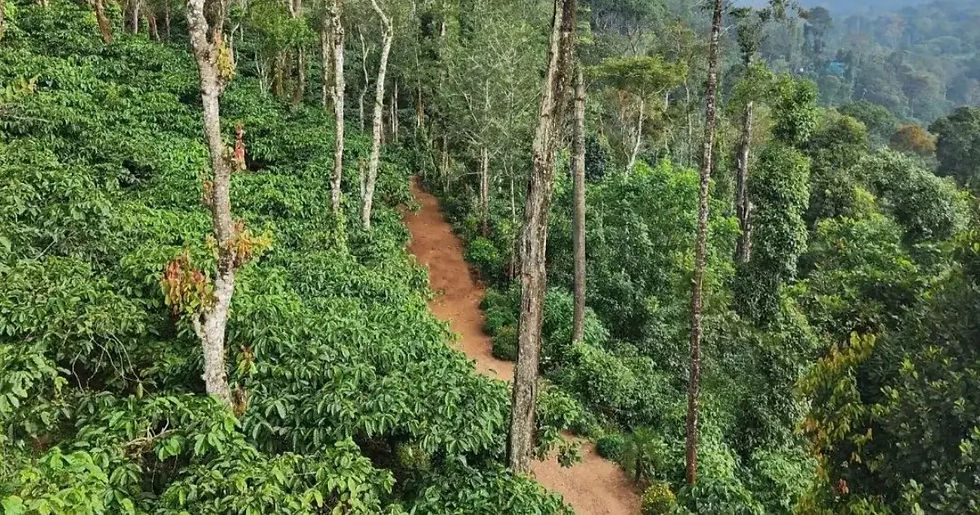
Figure 3. Coffee growing in hilly regions with a lot of forest cover
Procurement itself is adapting too. El Bueno describes harvest windows that used to be predictable with their Coorg and Ratnagiri partners now shifting season to season, pushing the roastery to commit to volumes earlier, sometimes before a year's lot has even been cupped, and to turn farmer check-ins into an ongoing dialogue about flowering conditions and soil moisture rather than a once-a-season call. BrewClan Coffee Roasters has moved to rolling four-month procurement cycles for the same reason: enough flexibility to react to price swings, without losing the consistency that long-standing estate relationships provide.
On the roasting side, specialty roasters are adapting profiles in real time: lower charge temperatures, slower yellowing phases on denser batches, and more conservative drum speeds to coax flavour out of beans that no longer behave the way they did a decade ago.
There's also a quieter shift happening at the species level: both BrewClan Coffee Roasters and El Bueno say they're actively exploring Fine Robustas and Excelsas.
Half Light takes a more conservative stance, open to any species that clears their specialty bar, but unwilling to compromise on that bar to solve a supply problem.
None of these are full solutions; they're adaptations buying time while the underlying climate math keeps shifting.
Conclusion: Preserving the Terroir
Here's the paradox at the heart of this story: market demand and export revenue are at historic highs, even as the biological foundation underneath premium coffee keeps depleting. Arabica is potentially being pushed toward its physiological limits by rising baseline temperatures and longer heatwaves across Karnataka.
Protecting it will take farmers and roasters working in collaboration, shade management and altitude strategy on one end, adaptive roasting craft on the other. But the deeper question isn't really about output anymore. It's about whether the perfect, complex flavour profile that India is known for can survive the conditions required to grow it or whether we're watching the slow, quiet sunset of one of the world's most delicate terroirs.
Sources
1. Coffee Board of India — Export Archive (1st January 2025 to 31 December 2025)
2. Coffee Board of India — Coffee Guide/crop science and temperature-band data. coffeeboard.gov.in
3. USDA Foreign Agricultural Service — Coffee: World Markets and Trade. fas.usda.gov
4. Coffee Board of India & International Coffee Organization (ICO) — Production, Bearing area, Yield, and Consumption data, 2013–14 to 2023–24 (July 2024 Data table).
5. Coffee Board of India — Karnataka regional production data and 2025–26 post-blossom estimates (data table).
6. Climate Central — heat-day tracking, coffee-growing regions, 2021–2025.
7. MSN.com — Chikkamagaluru temperature data, 2021–2025.
8. Sridhara et al. — long-term warming trend analysis, Chikkamagaluru, 1971–2007.
9. Karnataka State Natural Disaster Monitoring Centre (KSNDMC) — Climate Change Scenario in Karnataka: A Detailed Parametric Assessment (2020).
10. Environmental Management & Policy Research Institute (EMPRI) — Karnataka State Action Plan on Climate Change, Version 2.0 (2021).
11. Byrareddy et al. — Assessing Scale-Dependency of Climate Risks in Coffee-Based Agroforestry Systems (2024).
12. Coffee Board of India — 19th-century introduction of Robusta from Indo-China to combat coffee leaf rust (Coffee Guide).
13. Half Light Coffee Roasters — original interview conducted for this article.
14. BrewClan Coffee Roasters — original interview conducted for this article.
15. El Bueno — original interview conducted for this article.
16. Challender, J. (2023). Terroir: Coffee from seed to harvest. Barista Hustle.
17. Coffee Board of India — Indian Coffee, https://coffeeboard.gov.in/IndexContent.html
18. Rubinstein, Alexis. "India's Coffee Board Issues First 2026 Forecast, Proves Much More Optimistic Than USDA." StoneX Insights. February 9, 2026. stonex.com.
19. Figure 1. Cup of Coffee Americano by Prathan Chorruangsak
20. USDA Foreign Agricultural Service —Coffee Annual, IN2026-0026, May 2026 fas.usda.gov
21. Government of India, Press Information Bureau — India's Coffee Sector. pib.gov.in
22. Figure 2. Robusta Coffee King. Image generated using the prompt "A simple image of a coffee robusta roasted bean with a soft green background, a king crown over the bean of the coffee," by Devansh Chaturvedi, Gemini, 2026.
23. Figure 3. Coffee growing in hilly regions with a lot of forest cover


Comments